Why Talking About the Past Can Help Your Present

“What does my past have to do with anything?”
That’s a fair question. Let’s explore…
If you've ever considered therapy, you've probably had this thought: “what does my past have to do with anything? My problems are happening right now. I'm not interested in rehashing my childhood or dredging up old memories. I just want to feel better today.”
That's a completely fair question. Sometimes, going back into the past is not the right approach in therapy. However, therapy often visits the past at least at some point because most people who come to therapy are hoping to do more than just to keep their symptoms at bay; they want to experience some real healing. Solving a problem usually requires understanding its source. If a flat tire is making your car bang and rattle every time you drive, no amount of careful or strategic driving is going to fix the bang. At some point you may have to address the flat tire itself.
In therapy, we attend to flat tires of sorts. Emotional, interpersonal, spiritual, and relational flat tires. The trouble is, we often don’t even know that we have a flat tire to begin with; we just come in because of something that has come up that is distressing -- the bumpiness of the drive, or the banging noise when the car moves. In other words, we have some symptoms that we begin to notice that indicate something is not right. For some people, these are things like extreme anxiety, compulsive behaviors, or depression.
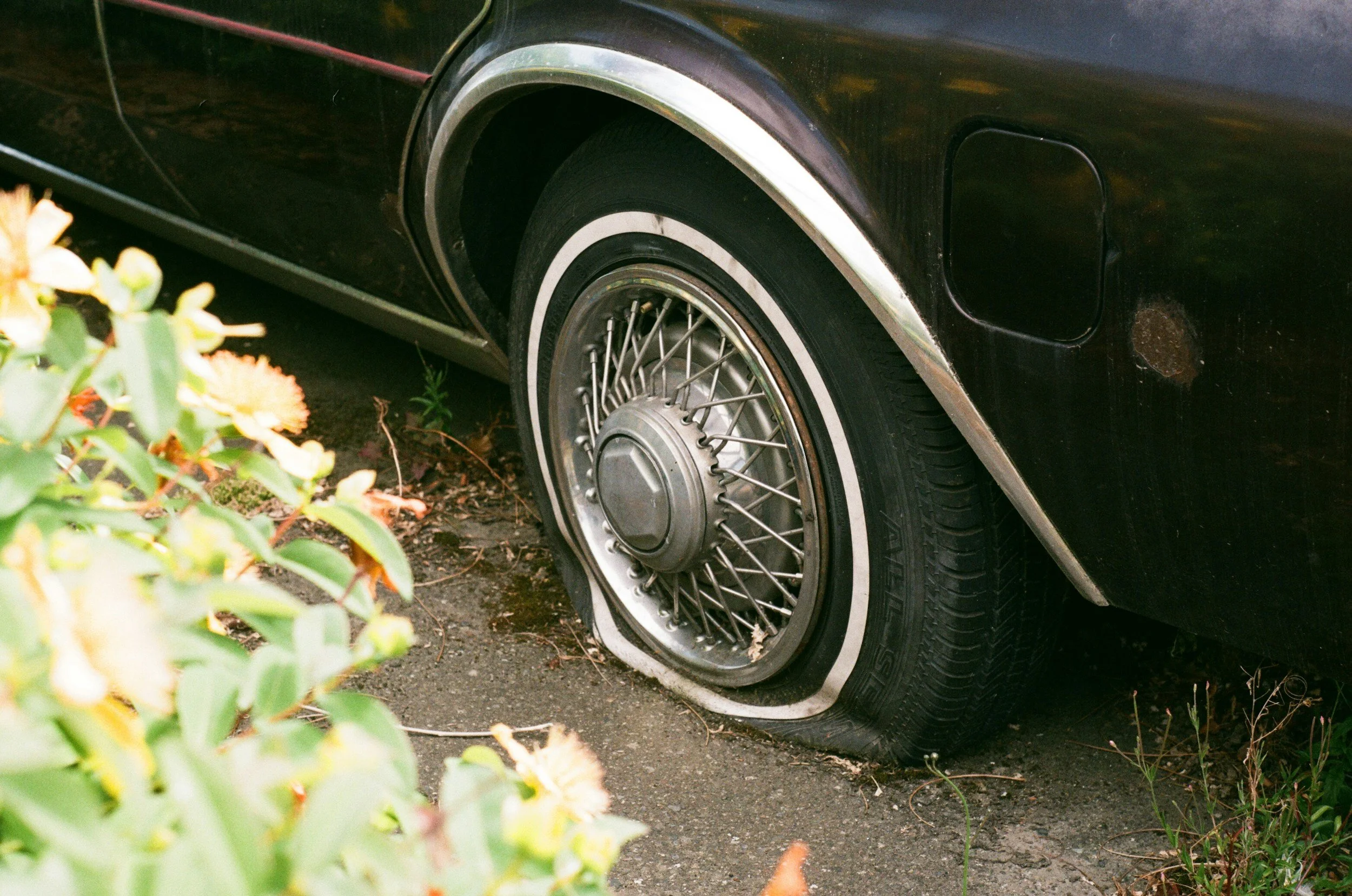
Therapy often visits the past because the flat tire can be older than we realized; we just didn't know we had it until the symptoms started making the ride unbearable.
Our interpersonal flat tires are much more nuanced than our car’s flat tires. They can be traumas we have experienced. They can be systems of coping that we learned early on that now begin to cause us problems. They can be relational experiences that implicitly taught us unconscious “rules” of how relationships work, without recognizing that we naturally carry those expectations into our current relationships. Usually we only make it to therapy when the symptoms catch up to us. But in the process of trying to heal these symptoms, a journey back to the root can be helpful. And for mental health symptoms, the journey can be quite far back.
Neuroscience and attachment research both suggest that our brain is most formative and most “plastic” when we are the youngest, and our early experiences with our caregivers are some of the most relationally and personally formative experiences we have. In other words, many of our
templates for relationships and coping systems are likely to have been formed in our early childhood, and addressing and re-experiencing these formative moments can help us find resolution to internal conflicts that show up today as symptoms. For many people, therapy naturally finds its way to earlier memories as patterns begin to emerge.
The healing work of therapy is not simply gaining insight into or remembering our past; it occurs because these painful experiences can be encountered differently, within a relationship that offers safety, curiosity, and understanding.
Therapy creates the space to actually re-experience and feel moments from our past that were painful to us, but this time with the tools, support, and stability to understand and consciously process them in healthy ways. When that experience from the past poked a hole in our tire, we may have been too overwhelmed, too unsafe, too young, or too alone to process it in a healthy way. Re-visiting these experiences with someone who sees you and wants to help you can be a deeply healing and corrective process which can alleviate symptoms in the present.
And of course, exploring the past does not mean that every session is spent analyzing your childhood. Therapy moves between the present and the past, helping us understand how these earlier experiences could be continuing to shape the challenges we are experiencing today.
References
Bowlby, J. (1988). A secure base: Parent-child attachment and healthy human development. Basic Books.
van der Kolk, B. (2014). The body keeps the score: Brain, mind, and body in the healing of trauma. Viking.
Siegel, D. J. (2012). The developing mind: How relationships and the brain interact to shape who we are. Guilford Press.