Master Your Emotions Without Abandoning Logic - The 5-Step Emotional Processing Framework

Emotions don’t have to feel chaotic or disruptive.
I often encounter clients who are either struggling to understand their emotions, or have difficulty figuring out what to do with them. They have often nearly perfected the use of logic or systems for their lives in hopes of limiting the unexpected and often chaotic intrusion they believe their emotions can cause. As someone who also appreciates logistics, systems, and structure, the struggle to know how to process emotion resonates with me. I have found using a formulaic tool for these logic-thinkers helps them to coordinate and tackle understanding and assimilating their emotions. This is not a tool to get rid of emotions, nor a way to make them “hurt less,” but a method for understanding, containing, and dealing with them.
The 5–Step Emotional Processing Framework is a structured, practical tool designed for thoughtful, analytical individuals who want a clear method for understanding and responding to their emotions.
Instead of suppressing feelings or letting them dictate behavior, this framework walks you through a simple process to:
Step 1 - Recognize It
Awareness you are having an emotion. The first step in processing an emotion or emotional experience is just to simply be aware that you are having some kind of emotional reaction or response to an event or experience. Being aware that your body is having some kind of physiological, internal, emotionally-connected reaction is vital to beginning the process.
Step 2 - Name It
Give it a name. Giving that emotion a name and identifying which emotion or emotions are occurring is crucial in moving through the tool. This is where an emotions word list or chart (of which there are many) is extremely helpful. Identifying the emotion by name externalizes it and makes it concrete.
Step 3 - Understand It
Understand why it is there. Sometimes it is obvious, other times it is not. But understanding why that particular emotion is coming up for you is important. If you get a flat tire on the way to work, it is understandable to be frustrated. This gives credibility to your response, and it leads into the next step.
Step 4 - Validate It
Validation is the part of the process where you allow the emotion to be there. It is ok that you feel what you are feeling- regardless of the nature of the emotion. Some feelings do not feel good, but that doesn’t mean they are bad. Validating them is essentially telling them you understand why they are there, and it is ok that they are there.
Step 5 - Choose It
Decide what to do with it. Validating a feeling does not necessarily validate the response we may choose. This is where the distinction between our choices and actions meets with our internal affect. Something happened, you had a feeling about it, gave it a name, understood why you felt what you felt, then validated it. Now you get to choose what to do with it. Do you want to go left or right? Do you want to address it or let it slide? This is the step where having someone to process with can be very helpful.
Remember, this is not a tool to eliminate unwanted emotions. Nor is it a way to change or control them. It is a method for understanding, containing, and dealing with feelings, and it is utilizing a logical mindset to do so. And while this is mostly an internal process, there is great value in communicating to others what we are feeling, and sharing with them our process and choice.
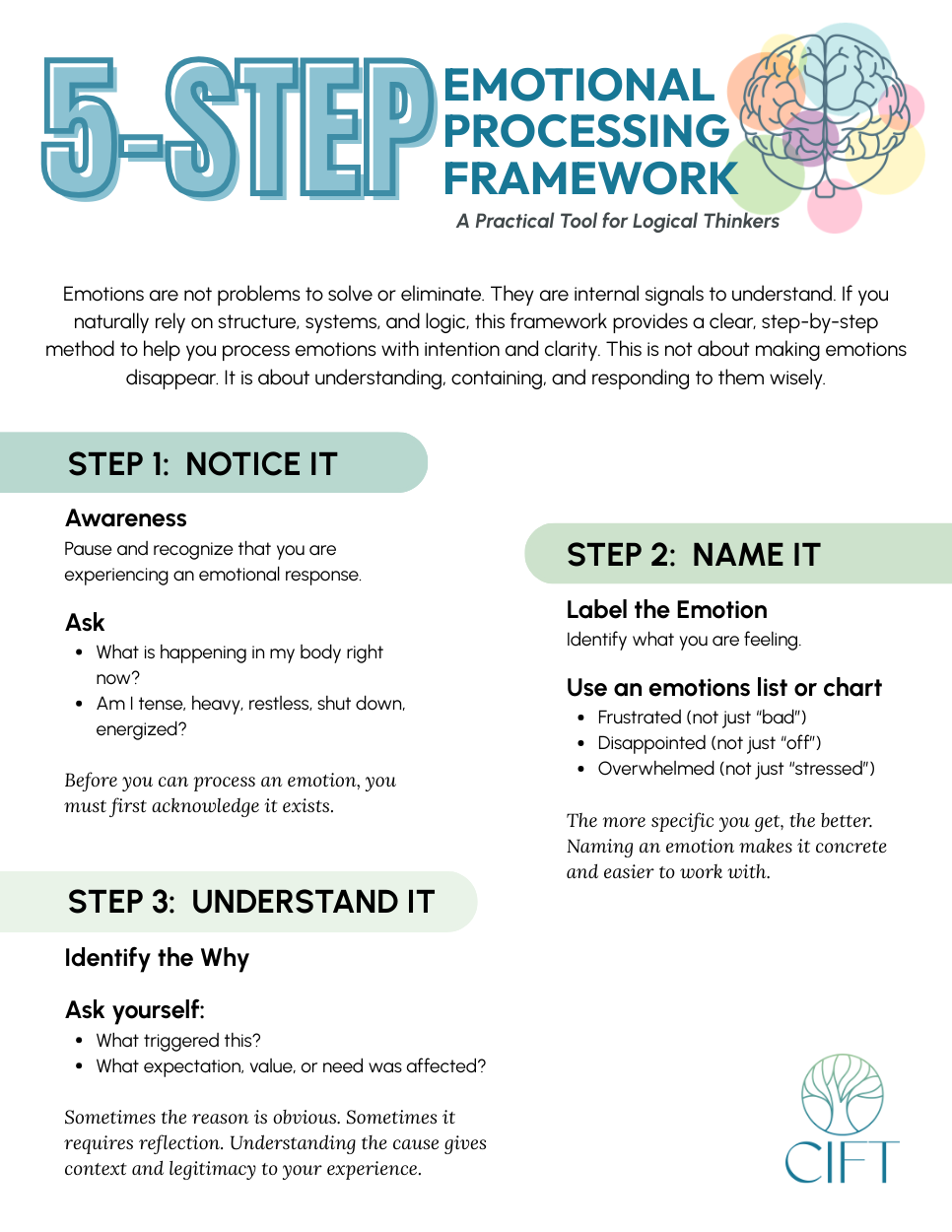
Download the free worksheet and begin approaching emotions with the same clarity and intention you bring to the rest of your life.